> [!NOTE]+ Meta
> Author:: Ignacio de los Reyes
> Reference:: https://www.bbc.com/news/health-32076070
> Date:: 2025
> Tags:: #warp
> WeftLinks:: [[Health value of craft]]
> Claim:: [[Claim - Hand skills play a role in medical procedures]]
> [!SUMMARY] Summary
> Indigenous Aymara women in Bolivia use traditional knitting skills to make tiny heart occluder devices by hand.
Indigenous Aymara women in Bolivia use traditional knitting skills to make tiny heart occluder devices by hand. The nitinol "top hat" plugs a hole in babies' hearts without open surgery and has saved hundreds of children. This low-cost, minimally invasive method fits high-altitude communities and respects local cultural concerns.
## Highlights
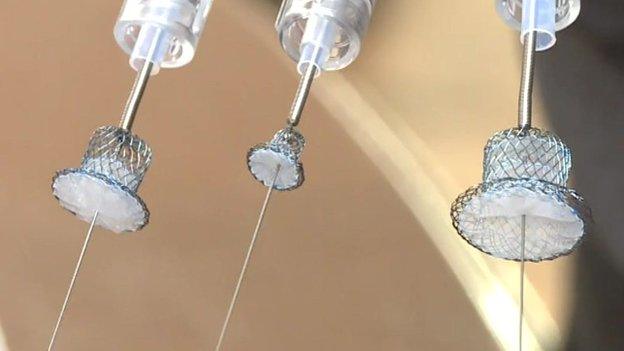
> It takes her about two hours to make the *Nit Occlud* device which was designed by cardiologist Franz Freudenthal. He set up his clinic in La Paz to help children born with heart problems and so far he has saved hundreds of lives.
> The device, known as an occluder, looks similar to a top hat and is used to block the hole in the patient's heart.
> Most standard occluders are made on an industrial scale - but Freduenthal's version is so small and intricate that it's technically tricky to mass produce.
>
> Freudenthal's devices are made by weaving a single strand of a super-elastic metal used in military industries.
>
> This minimally invasive approach also helps to avoid cultural barriers to treatment: manipulating a heart is considered an act of desecration on the human soul by some indigenous communities in Bolivia.
> "By not operating with an open heart" says Dr Freudenthal, "We are also respecting the will of many patients who would not want their children to be operated otherwise."
>
> Due to the high altitude and lack of oxygen in La Paz - 4,000 metres above sea level - Freudenthal says that these kind of problems are 10 times more frequent here than in other countries.